
17.02.2026 à 16:00
As crypto industry expands, U.S. slashes office examining dirty money safeguards of cryptocurrency exchanges
Texte intégral (1031 mots)
As cryptocurrency use in the United States surges, the number of federal investigators assigned to review safeguards against dirty money in the industry plummeted last year to the lowest level since at least 2017, according to federal data obtained by the International Consortium of Investigative Journalists.
The cuts weaken the anti-money laundering watchdog’s office within the U.S. Internal Revenue Service, which is tasked with overseeing protections against dirty money in crypto exchanges and other firms registered as so-called money service businesses. Even before the recent reductions, the IRS struggled to oversee dirty money in the fast-growing crypto sector, according to experts. The cuts come amid the Trump administration’s broader easing of oversight of crypto exchanges that now move trillions of dollars in value annually.
“The reduction in supervisory staff at the IRS matches a trend we’ve seen across [anti-money laundering] enforcement agencies,” said Erica Hanichak, deputy director at the FACT Coalition, a Washington-based nonprofit group that advocates for strong safeguards against illicit financial flows. “This sends the signal that the US is open to dirty money. It undermines our national security and market integrity.”
The IRS did not respond to requests for comment.
Even as the industry has sought mainstream acceptance, cryptocurrency has played a key role in recent money laundering scandals.
Last November, ICIJ collaborated with 37 media partners in 35 countries to publish The Coin Laundry, an investigation into dirty money in the cryptocurrency industry. The investigation revealed that as recently as July 2025, Huione Group, a Cambodian financial institution flagged by US authorities in May as a “primary money laundering concern,” sent large sums of cryptocurrency to accounts at some of the world’s largest cryptocurrency exchanges, including Binance and OKX.
These fund flows continued even after US authorities found major problems relating to the firms’ anti-money laundering protocols.
Recommended reading
goal of many crypto-reliant money launderers.U.S. regulators classify crypto exchanges in the same category as so-called money services businesses (MSBs) like Western Union. Even before last year’s cuts, the IRS office tasked with overseeing these businesses struggled to adequately supervise cryptocurrency operations, according to the agency’s inspector general.
In 2021, then-IRS commissioner Charles Rettig told Congress in a letter that the agency needed more staff to address the “rapidly evolving and expanding” cryptocurrency industry. That year, the IRS had 193 agents
tasked with examining the anti-money laundering protocols of crypto exchanges and other MSBs, significantly more than in 2025, according to federal data.
“Conducting MSB examinations is an inherently laborious activity,” Rettig said in the letter. “[Examiners] need reinforcements to conduct more examinations of both traditional and digital asset MSBs, especially money transmitter principals. Increased funding for personnel and expenses, such as travel and analytical tools, is also necessary to supervise MSBs.”
The following year, in 2022, Congress awarded the IRS tens of billions of dollars in additional funding, and the agency began rapidly expanding its ranks and embarked on a push to modernize its systems. But, early last year, the Trump administration’s cost-cutting stopped this effort in its tracks, rapidly firing many of the new hires as Republicans in Congress also clawed back much of the new funds awarded to the agency.
In April, the new administration also disbanded a Justice Department unit that investigated crypto-related crimes. In doing so, the department saidit would still “pursue the illicit financing of these enterprises by the individuals and enterprises themselves, including when it involves digital assets, but will not pursue actions against the platforms that these enterprises utilize to conduct their illegal activities.” The Trump administration also quickly dropped enforcement actions against more than a dozen cryptocurrency firms, and the president pardoned several crypto executives who had pleaded guilty to violating anti-money laundering laws.
Cryptocurrency oversight is a very loosely knitted-together safety net.
— Alison Jimenez, an anti-money laundering expert
In 2025, the number of IRS investigators assigned to oversee the dirty money defenses of crypto firms and other money transmitters fell 33 percent to 139 agents, down from 208 in 2024.
The falling numbers do not necessarily equate to layoffs, but rather the number of agents assigned to examine anti-money laundering practices in so-called nonbank financial institutions, which include cryptocurrency exchanges and other MSBs. The 2025 number is the lowest in the dataset, which dates back to 2017. ICIJ obtained the data through a public records request. Some U.S. states also supervise anti-money laundering practices at MSBs.
Christina Rea, a compliance specialist who advises crypto firms on IRS anti-money laundering examinations, says the agency appears to be struggling to keep pace with overseeing dirty money safeguards in cryptocurrency. Rea says a small and dwindling group of IRS agents who possess deep virtual currency experience are tasked with overseeing a booming and highly complex new financial sector.
“What’s notable is that this contraction appears to be happening while the regulated crypto and fintech ecosystem has grown dramatically in scale, transaction volume, product complexity and risk exposure,” Rea told ICIJ. “Compared to 2017 and 2018, today’s firms are larger, more interconnected with traditional financial institutions, and operating far more sophisticated platforms, and yet examiner resources appear to have decreased rather than expanded.”
Jimenez said. “They are larger than a lot of banks but they are not getting the frequency of examinations or the in-depth examinations that banks get. If there are violations found, there is often no formal action taken.”Jimenez said that fewer examiners overseeing crypto exchanges and other money transmitters could mean more problems with anti-money laundering safeguards will go undetected for longer and could eventually balloon into larger scandals that hurt consumers and damage the broader industry.
“Cryptocurrency oversight is a very loosely knitted-together safety net,” Jimenez said. “Now it’s just getting pulled farther apart.”
11.02.2026 à 00:46
Nearly half of powerful .50-caliber ammo seized by Mexican government came from US Army plant, defense minister says
Texte intégral (604 mots)
A United States Army ammunition plant was the source of almost half of all the .50-caliber rifle rounds seized by Mexican authorities over more than a decade, the country’s defense minister told reporters Tuesday, after an investigation by the ICIJ and media partners revealed how the powerful ammunition has been used by Mexican drug cartels in attacks on the government and civilians.
“According to the records we have,” Defense Minister Gen. Ricardo Trevilla Trejo said during a presidential news conference, “137,000 cartridges have been seized since 2012. Of those, 47% come from that company and have been sold in gun shops in the southern United States,” referring to the Lake City plant.
The sprawling, government-owned facility, which is located outside of Kansas City, Missouri, is the largest manufacturer of rifle rounds for the U.S. military and has been a major supplier of ammunition to American consumers for over two decades.
Agreements between the U.S. Army and the private contractors that run Lake City have allowed .50-caliber ammunition and components made at the plant to enter retail markets and fall into the hands of Mexican cartels, according to millions of pages of court documents, seizure records and government data obtained by ICIJ and its partners.
Recommended reading
obtained by ICIJ and partners showed that Mexican authorities found cartridges inscribed with Lake City’s initials, “L.C.”, following at least four attacks carried out by criminal organizations in Mexico. The incidents included the massacre of 13 policemen in the state of Michoacán and an attack on the town hall in the small village of Villa Unión, where four police officers, two civilians and 19 cartel members were killed.Mexican authorities have long lamented that the illegal flow of firearms from the U.S. to Mexico has been a major contributor to violence in the country, empowering cartels to wage military-style attacks on authorities.
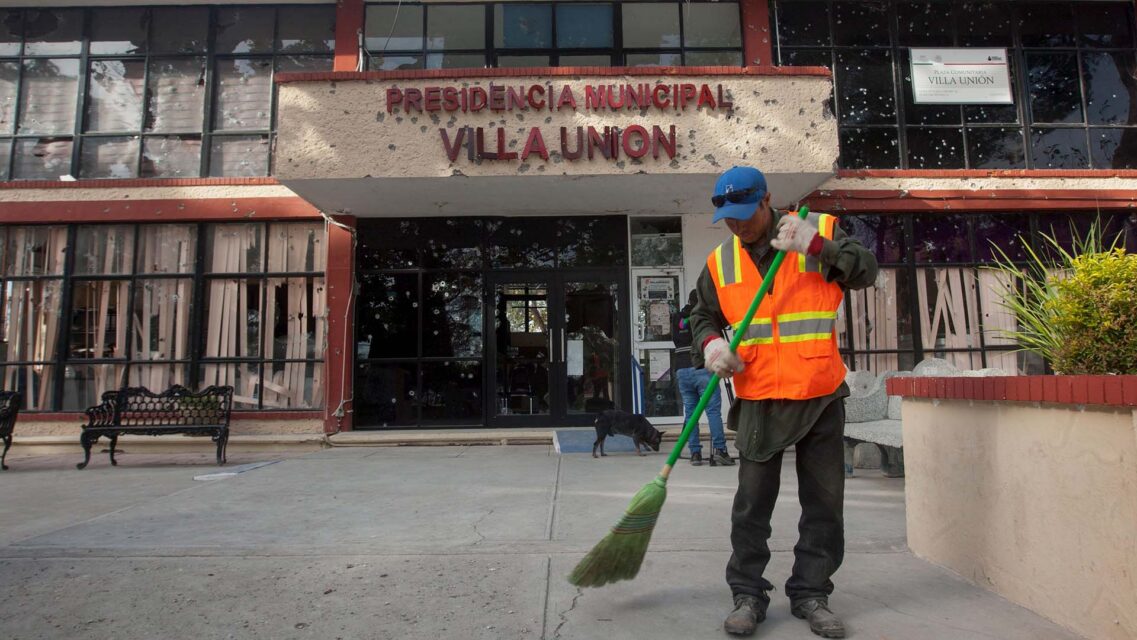
A man sweeps outside the Municipal Presidency in Villa Unión, Coahuila state, Mexico, on December 2, 2019, after an armed attack on the town which left multiple people dead. Image: Julio Cesar Aguilar/AFP via Getty Images
As of spring 2022, .50-caliber guns had been used in at least seven attacks on Mexican military and police helicopters, according to an ATF briefing at that time.
The Mexican government has seized 18,000 firearms under President Claudia Sheinbaum, who took office in late 2024, Trevilla Trejo said. Of those, 78% originated in the U.S.
They included 215 .50-caliber rifles. The guns, which are nearly five-feet long and weigh around 30 pounds and have limited civilian application, can be bought in gun shops around the U.S.
They have become popular among Mexican cartels, who have used them to down helicopters, assassinate government officials, shoot at police and military forces and massacre civilians, killing at least 121 people in 87 attacks since 2003, according to an ICIJ count based on news stories, academic studies and government records.
While the trafficking of guns into Mexico from the U.S has been widely reported, less is known about the millions of rounds of ammunition experts say are flowing across the southern border each year. In the U.S., there are virtually no federal restrictions on the purchase of ammunition by American citizens and legal residents.
07.02.2026 à 10:58
Mexican cartels overpower police with ammunition made for the US military
Texte intégral (3046 mots)
On the morning of Nov. 30, 2019, a convoy of pickup trucks carrying men armed with a heavy machine gun and powerful .50-caliber rifles entered the Mexican town of Villa Unión and opened fire.
The men had been sent on a mission of intimidation: They planned to set fire to the town hall. Their superior firepower pinned down state and local police officers as they waited for military reinforcements. Terrorized residents scrambled to take cover from the hail of bullets.

Luis Manzano, 27, a local Villa Unión reporter who drove into town during the shootout. Image: Marian Carrasquero / The New York Times
The smell of smoke filled the streets and spent casings covered the ground like “fallen leaves,” said Luis Manzano, a Mexican journalist who drove into town during the shooting. But his most vivid memory was the thunder of .50-caliber guns. The “ground trembled” as they fired, he said. “I had never experienced anything like that.”
The military drove off the assailants. In the end, four police officers, two civilians and 19 cartel members were killed. Afterward, as investigators collected evidence from the scene, they gathered at least 45 .50-caliber casings stamped with the initials “L.C.”
The letters stand for the Lake City Army Ammunition Plant, a sprawling facility just outside Kansas City, Missouri, that is owned by the U.S. government and is the largest manufacturer of rifle rounds used by the American military.
It has also been a major supplier of ammunition for American consumers, including .50-caliber cartridges. These powerful rounds — as big as a medium-sized cigar and designed to be used by the military to destroy vehicles and light aircraft — are currently available for purchase by civilians across the United States.
Millions of pages of court documents, seizure records and government data obtained by the International Consortium of Investigative Journalists and The New York Times show how agreements between the Army and the private contractors that run Lake City have allowed .50-caliber ammunition and components made at the plant to enter retail markets and fall into the hands of Mexican cartels.
Mexico’s government has also purchased Lake City ammunition, the documents show, although they do not indicate the caliber.
The U.S. domestic market for the ammunition is small: .50-caliber rifles, which have limited civilian application, typically retail for thousands of dollars, and heavy machine guns like the one used in Villa Unión cost considerably more. The guns’ standard cartridges average between $3 and $4 apiece and are rarely purchased by American gun owners.
But in Mexico, where cartels have deep pockets and a seemingly endless appetite for .50-caliber firearms, demand is high.
Cartel gunmen armed with .50-caliber firearms have downed helicopters, assassinated government officials, shot at police and military forces, and massacred civilians.

A police officer holds a round of .50 caliber ammunition in Villa Unión. Image: Marian Carrasquero / The New York Times
Since 2012, the U.S. Bureau of Alcohol, Tobacco, Firearms and Explosives has seized more than 40,370 rounds of .50-caliber ammunition in states bordering Mexico, according to data obtained through public records requests. Lake City’s product accounted for about a third of them, a larger share than any other manufacturer.
While .50-caliber ammunition from other companies — located primarily in Brazil and South Korea — has also made its way to Mexican cartels, the data makes clear that the U.S. Army plant has been a major source of the destructive ammunition being used to wage military-style battles with Mexican authorities.
This includes a particularly powerful version of Lake City’s ammunition — incendiary rounds capable of piercing armor, which were used in an attack on Mexican police in 2024 and are for sale online today
In February of last year, the Trump administration declared six Mexican cartels to be foreign terrorist organizations, yet these same organizations are acquiring ammunition made at the plant owned by the U.S. Army.
At least 16 online retailers have sold armor-piercing ammunition made at Lake City or made with components from the plant, according to a count by ICIJ and The Times.
Vasily Campbell, who owns one of those businesses, said he stopped selling the ammunition “about two years ago once we found out where it was going and how it was getting there.”
He said he became suspicious when buyers began asking to have 100-round ammo cans delivered to residential addresses. “That’s not a normal purchase,” he said. “There’s several orders I straight-up canceled.”
The U.S. Army did not respond in detail to questions about the use of Lake City ammunition by drug cartels. In an email, a spokesperson said that allowing commercial sales from the plant has saved taxpayers around $50 million annually, primarily by lowering the government’s cost for ammunition.
The impact that one .50-cal has in a firefight is outrageous … They really, really tip the scale — former ATF agent Chris Demlein
Successive presidential administrations have pledged to crack down on the flow of arms to Mexico. And in September, Secretary of State Marco Rubio announced a new initiative with the Mexican government to stop gun trafficking to the country.
The number of .50-caliber rounds seized is small compared with that of other cartridges. But it’s the power of the .50-caliber ammunition, not its quantity, that has made it a game changer for the cartels, giving them the ability to overwhelm police and even the military, according to Chris Demlein, a former ATF agent, who spent years investigating gun smuggling to Mexico.
“The impact that one .50-cal has in a firefight is outrageous,” he said. The weapons allow cartels to engage with targets at distances of more than a mile: “They really, really tip the scale.”
ICIJ and the Times obtained investigative files from three incidents involving .50-caliber rifles, including the assault on Villa Unión. In each of them, Mexican authorities reported finding casings marked with the Lake City imprint.
In a fourth example in early 2024, gunmen used the more destructive variant, .50-caliber armor-piercing incendiary rounds, from Lake City to attack a police convoy, according to a press briefing given by then Defense Secretary Luis Cresencio Sandoval. One of the bullets pierced an armored vehicle, killing one of the crew members and wounding three others. “The armor that we have cannot protect our personnel from this kind of penetration,” he said.

Brenda Aparicio Villegas’ husband, Edder Paul Negrete Trejo, was one of 13 police officers killed in October 2019 in an ambush in Michoacán. Image: Enrique Castro
Brenda Aparicio Villegas is all too familiar with the devastating power of .50-caliber weapons. Her husband, Edder Paul Negrete Trejo, was a police officer who died on October 14, 2019 when he and his fellow police officers were ambushed in the western state of Michoacán. Authorities blamed the attack on the New Generation Jalisco Cartel, news media reported at the time.
Her husband and his colleagues — who often had to purchase their own bullets — did not stand a chance against the cartel’s .50-caliber rifles, she said. Negrete, the father of three children, died from a gunshot wound to the chest. Twelve other officers were also killed in the attack, including one who burned to death. Investigators later found .50-caliber casings from Lake City at the scene.
Not enough has been done to stop the flow of guns and ammunition to Mexico, Ms. Villegas said. “Sadly, many of us pay the price.”
Recommended reading
caliber rounds were rarely found beyond military training grounds and battlefields. However, that began to change in 1982 with the invention of the first .50-caliber rifle. The gun was almost five feet long and weighed around 30 pounds, making it difficult to fire from a standing position. But its greatly reduced recoil allowed users to shoot the heavy cartridges with sniper-like accuracy.The rifle made its official battlefield debut during the first Gulf War in the early ‘90s.
It had already developed a cult following among gun hobbyists, who used it in long-range target shooting contests. There weren’t many sources of ammunition for civilians: the rifles’ owners sought out antique and imported rounds, bought them from boutique manufacturers or made their own, using bullets and casings purchased from specialty shops.
Then there was the U.S. military. In the late ‘90s, government auditors found that Talon Manufacturing Co., a company contracted by the Department of Defense to demilitarize unneeded ammunition (a process that destroys a weapon’s military capabilities by means such as scrapping or disassembling it), had sold some of it to civilian retailers, including over 100,000 armor-piercing incendiary .50-caliber rounds. Rather than scrapping the ammunition, the company had broken it down and then built new cartridges with the components.

Outside the Lake City Army Ammunition Plant in Independence, Missouri. One person was killed and four were injured in an accident in 2017. Image: Emily Rhyne for The New York Times
Ammunition dealers told undercover government investigators that the armor-piercing bullets could shoot down a helicopter or penetrate an armored limousine. In effect, “the U.S. military is indirectly arming civilians with some of the most powerful and destructive ammunition currently available,” a congressional report concluded.
In 2000, Congress passed a bill that prohibited the Pentagon from selling armor-piercing ammunition for .50-caliber weapons to the public. It instructed the Defense Department to require anyone receiving armor-piercing ammunition or components from it to pledge not to transfer the materials to “any purchaser in the United States other than a law enforcement or other governmental agency.”
The legislation did not address standard, non-armor-piercing cartridges, known as “ball” rounds. Talon continued selling that ammunition, made with Lake City components, until 2007, when environmental and safety concerns led the company to stop operations.
A new supply of Lake City rounds soon emerged, however. Concerned about the potential for ammunition shortfalls during the global war on terror, Army planners allowed Lake City’s operator, ATK, to ramp up commercial activity at the plant in exchange for guarantees that the company would maintain the ability to produce more than 1.6 billion rounds of ammunition a year. That included 60 million .50-caliber cartridges.
By the end of 2008, ATK had begun selling some of that ammunition to retailers.
nment officials, according to U.S. District Court documents.As the years went by, incidents of cartel violence increased substantially, and attacks with .50-caliber weapons became more frequent.
In May 2011, cartel members forced down a Mexican Federal Police helicopter in the western state of Michoacán. A few days later, gunmen armed with weapons including a .50-caliber rifle fired on four more helicopters.

A police convey in Michoacán, Mexico. Image: Enrique Castro
Back in the U.S., Lake City was becoming a major source of .50-caliber “ball” ammunition. By 2013, 10-round boxes of the cartridges had become so widely available that they even showed up in some Walmarts.
Online, cartridges linked together for use in a machine gun were available in 100-round ammo cans, just like those used by the military, often at significant discounts compared to other manufacturers.
One popular website, Lucky Gunner, extolled Lake City ammunition’s power: “If you’re looking to stop a Jeep dead in its tracks, then you’re looking at the right round.”
Starting in 2015, Mexico saw a steep escalation in violence, with homicides climbing for three consecutive years, according to official data. In border states, U.S. agents soon began monitoring bulk ammunition vendors as a way to find gun smuggling operations, according to Jason Red, a former investigator at the Department of Homeland Security in Arizona.
In a typical scenario, retailers would sell large quantities of ammunition to a civilian, who would then give it to a smuggler. With few exceptions, almost any U.S. citizen or legal resident 18 or older can buy any type of rifle ammunition — even of the armor-piercing variety — in any quantity, but taking it across the border requires a license.
“Our mantra became, follow the ammo and you’ll get to the guns,” Red said in a recent interview. “We were tracking shipments from all over the country.”
The team seized hundreds of thousands of rounds of ammunition likely bound for Mexico, according to Red and court records. The vast majority of the ammunition was 7.62-mm rounds, most commonly used in AK-47s, he said.
Seizures of .50-caliber ammunition were small and infrequent at the time, according to ATF and Customs and Border Protection (CBP) records.
Our mantra became, follow the ammo and you’ll get to the guns. — former investigator Jason Red
But as American authorities introduced new initiatives and increased resources aimed at reducing gun trafficking to Mexico, the numbers grew.
Between 2019 and 2024 the ATF seized more than 36,000 rounds of .50-caliber ammunition in border states. About a third of them were identified as coming from Lake City.
During the same period, CBP seized nearly 21,400 units of .50 caliber ammunition. This included 2,850 of the armor-piercing incendiary rounds.
acted with the company to demilitarize unneeded ammunition from Lake City, American Marksman wrote on its website, adding that it “gets many of its components from its Lake City recycling operations.” That included components for its armor-piercing incendiary rounds.Olin Winchester’s policies on the sale of .50-caliber ammunition from Lake City are unclear. The company’s catalog does not offer the rounds for sale to civilians. But Lake City cartridges and components, including armor-piercing incendiary rounds and bullets, have continued to appear on the market.
Pallets of the armor-piercing incendiary ammunition, labeled with a code denoting they were manufactured by Olin Winchester at Lake City, were being sold by at least one online retailer in March 2023. And American Marksman continues to sell armor-piercing incendiary ammunition on its website. (It is unclear which Lake City contractor manufactured the components used to make those rounds.)
In January 2022, the Department of Justice announced the indictment of members of a gun trafficking ring, run by a former U.S. Marine, that sold guns and ammunition, including .50-caliber rifles, to the Jalisco Cartel, the same group that was accused of killing Villegas’s husband, the police officer. Four months later, the Marine pleaded guilty.
During the operation, U.S. federal agents seized approximately 10,210 .50-caliber armor-piercing incendiary rounds with Lake City markings. There is no indication that the ammunition came from American Marksman or SGAmmo.

Outside the Lake City Army Ammunition Plant in Independence, Missouri. Image: Emily Rhyne for The New York Times
In an email, the Army said that Lake City’s contractors are “required to comply with all federal and state regulations governing the sale of commercial ammunition. While the operating contractor does not sell directly to the public, it sells to distributors, resellers, and retail stores, which are also required to adhere to federal, state, and local laws regulating ammunition sales.”
Olin Winchester did not respond to a detailed list of questions about its Lake City operations and its policies on the sale of .50-caliber ammunition and components made at the facility.
In an email, Northrop Grumman said that it “fully complied with government contract obligations in its sales of ammunition” during the two years it ran Lake City. SGAmmo did not respond to multiple emails about its purchases of .50-caliber ammunition. American Marksman also declined to comment.
letholes-mayor-NYT-768x432.jpg 768w, https://media.icij.org/uploads/2026/02/Villa-Union-bulletholes-mayor-NYT-1536x864.jpg 1536w, https://media.icij.org/uploads/2026/02/Villa-Union-bulletholes-mayor-NYT-1109x624.jpg 1109w, https://media.icij.org/uploads/2026/02/Villa-Union-bulletholes-mayor-NYT.jpg 1920w" sizes="auto, (max-width: 1138px) 100vw, 1138px" /> Villa Unión’s former mayor Sergio Cárdenas in his butcher shop, right. Buildings in the town still sport bullet holes from the 2019 attack.Image: Marian Carrasquero / The New York Times
Authorities traced one of the .50-caliber guns used in the assaultto a store in Texas. The owner, investigators found, had sold nearly 500 guns that ended up in the hands of the C.D.N, including a .50-caliber machine gun and at least six .50-caliber rifles. A federal court sentenced him to 10 years in prison, following a guilty plea.
American authorities indicted 14 members of the gun-smuggling ring, seizing over 2,300 rounds of Lake City ammunition.
Upon learning that the .50-caliber rounds he had heard in Villa Unión came from an ammunition plant owned by the U.S. Army, Cárdenas did not seem surprised.
“The drug traffickers can get their hands on anything,” he said. “And they get the best weapons from the United States.”
Times reporter Emiliano Rodríguez Mega reported from Mexico City and Villa Unión, Mexico.
Contributors: Jesús Escudero, Miguel Fiandor Gutiérrez, Delphine Reuter (ICIJ); Paulina Villegas (NYT); Mathieu Tourliere (Proceso, Mexico).
06.02.2026 à 12:42
Former Nigerian oil minister stands trial in the UK on bribery charges
Lire plus (494 mots)
The trial of Diezani Alison-Madueke resumed this week in the Southwark Crown Court in London, with prosecutors alleging that the former Nigerian oil minister once blew about $190,000 (140,000 GBP) on a shopping spree for furniture and art that was paid by intermediaries.
The trial, which began in January, is the latest milestone in a longstanding corruption investigation across multiple jurisdictions.
Alison-Madueke, 65, who is currently out on bail, was minister from 2010 to 2015 under President Goodluck Jonathan and chaired the Organization of the Petroleum Exporting Countries, OPEC, for part of that time. She was first questioned by British authorities in 2015, and formally charged in 2023 on several counts of bribery.
Britain’s National Crime Agency accused her of improperly influencing multimillion dollar oil contracts in return for bribes, including at least $137,000 (100,000 GBP) in cash. Prosecutors allege she “enjoyed a life of luxury in London” that included the use of several London properties and service staff, furniture, school fees for her children, private flights and chauffeur-driven cars.
repatriation of over $52 million in forfeited funds that were proceeds of corruption.Assets seized by the U.S. included prime real estate in New York and California, and the superyacht Galactica Star.
st week, the U.K. court heard how the bank cards of Aluko and his company Tenka Limited paid about $2.5 million (more than 2 million GBP) for Alison-Madueke’s shopping sprees at London’s famous departmental store, Harrods. Tenka also allegedly paid for staff and refurbishments at the property that Alison-Madueke used.Aluko rose to prominence during Alison-Madueke’s stint as minister, when Nigeria’s government awarded lucrative oil blocks to companies linked to him on a no-bid basis. One of those companies was created the day before it was granted a multimillion dollar licensing deal.
Recommended reading
first appeared in court in 2015, Mossack Fonseca helped Aluko obtain a $30 million home loan.In July 2016, Nigerian authorities charged Aluko alongside several others with ties to the former minister, but his name was later dropped from the charge sheet. State prosecutors admitted that they had been unable to locate him and serve him with court papers.
In 2022, a Nigerian appeals court upheld the decision to seize Nigerian properties belonging to Aluko, including a mansion valued at $19 million.
In Alison-Madueke’s trial, which is expected to last for about three months, her lawyer maintains that she was merely a “rubber stamp” for official decisions that she had no real influence over.
According to media reports, her lawyer told the court that payments were made on her behalf “because Nigerian ministers are forbidden from having bank accounts abroad”, and that the payments were reimbursed.
05.02.2026 à 16:27
Canada names first foreign interference watchdog
Lire plus (275 mots)
After years of alarms raised by experts and civil society groups about transnational repression, the Canadian government has named its first foreign interference watchdog, ICIJ’s media partner CBC News reports.
Former British Columbia chief electoral officer Anton Boegman, nominated by the federal government, will take on the new position, CBC News reports. The seven days given to opposition parties to respond lapsed this week.
The new watchdog comes less than a year since ICIJ’s China Targets investigation revealed how Chinese authorities use extensive surveillance, pressure on family members, hacking and other tactics to target regime critics living overseas.
The collaboration of over 40 media partners worldwide featured interviews with 105 targets, alongside internal Chinese government records spanning two decades, to reveal a coordinated, systematic and global effort by the Chinese government to neutralize dissent in all forms.
In Canada, CBC News uncovered cases of intimidation and harassment against a Hong Kong pro-democracy advocate in exile and a pro-Taiwan activist that included the circulation of deepfake, sexually explicit images online and threats against the activist’s family members still living in China.
Lawmakers have repeatedly emphasized the issue as a priority; in the time since, CBC News reports, the results of a foreign interference inquiry concluded transnational repression was a “genuine scourge” in Canada, citing China as the “most active perpetrator of foreign interference targeting Canadian democratic institutions.”
Recommended reading
04.02.2026 à 10:29
Beijing’s backtrack on Xinjiang detention camps spurred by ICIJ investigation, research finds
Texte intégral (886 mots)
Reporting by the International Consortium of Investigative Journalists helped force a shift in Beijing’s public stance on Xinjiang, according to new academic research — from denying the existence of a vast detention camp system to justifying it and, eventually, to partially dismantling it.
In an article published in Modern China, a peer-reviewed academic journal dedicated to China studies, political scientist Jan Švec traces how China responded to growing global scrutiny of its “re-education” campaign in Xinjiang between 2014 and 2022. Švec, who’s based at the Institute of International Relations in Prague, used official Chinese documents, state media analysis, leaked files, and international reporting to argue that international exposure played a decisive role in forcing Beijing to adjust both its narrative and its policies.
Following ethnic rioting, and a series of deadly terror attacks within and outside Xinjiang which Beijing blamed on Uyghurs, President Xi Jinping launched a “Strike Hard Campaign against Violent Extremism” in 2014 that framed Uyghur identity as a security threat. Local authorities experimented with so-called “de-extremization” centers, openly praising them in regional media. At this stage, there was little international awareness — and little effort to conceal what was happening.
That changed dramatically in 2017, when mass detentions expanded across the region. As arrests surged, Beijing imposed a strict information blackout. References to the camps disappeared from national media, and Xinjiang coverage was softened to emphasize development and stability. But outside China, journalists, researchers and Uyghur exile groups began piecing together evidence of mass incarceration.
Švec says a turning point came in late 2019 after the U.S. imposed sanctions over the repression of Uyghurs and ICIJ published the China Cables, a trove of leaked internal documents that laid bare how the camps operated. The files included detailed instructions on surveillance, discipline and indefinite detention, confirming in the Chinese government’s own words what survivors and investigators had long alleged: the camps were coercive, centrally coordinated and part of a sweeping program of mass surveillance and population control.
China, which denies human rights abuses and says religious freedom is respected in Xinjiang, responded to the China Cables investigation by decrying it as “pure fabrication and fake news.”
China Cables and a second leak published that November by the New York Times called the Xinjiang Papers — which included internal speeches and documents confirming the central authorities endorsed the mass repression — had immediate impact. Google searches for “Xinjiang” surged by 236 percent between September and December of 2019, according to Švec.
“The leaked documents and the imposition of sanctions significantly heightened the public attention on Xinjiang in late 2019,” he wrote.
According to Švec, Chinese officials reacted to the leaks as forcefully as they did to Western sanctions. State media launched aggressive attacks on critical media reports, while diplomats scrambled to counter the damage.
“In one response, the official media deemed it necessary to say that Western media ‘cannot have any actual influence’ and ‘just cannot do anything about it’. An officially published letter by a former ‘student’ of one of the camps urged Americans to ‘shut up,’ ” Švec writes.
Yet just days after the China Cables were published, authorities announced that all camp “trainees” had “graduated,” signaling an abrupt policy shift.
Recommended reading
al, partial acknowledgment, formal legalization, downsizing and eventual abandonment of the camps as a visible policy. He says detention facilities were physically dismantled or repurposed, and references to the camps vanished from official discourse after 2020.Crucially, he says, these changes began before major sanctions were imposed, suggesting that exposure and “naming and shaming” were more influential than economic penalties alone. “China explicitly reacted to investigative findings,” Švec wrote, adjusting its approach even as it publicly insisted it had done nothing wrong.
Švec adds, “Nevertheless, although the first sanctions were adopted only in October 2019, the threat of their imposition had existed since at least 2018, and their influence on the decision making of the authorities cannot be excluded as well.” He states that China’s decision to retreat from the policy of mass internment in Xinjiang was most likely shaped by a combination of international pressure and the perceived reduction of security threats.
Švec argues that his findings challenge the widespread belief that China is immune to international criticism on sensitive domestic issues like Xinjiang. Instead, it suggests that Beijing is deeply concerned about its global image — particularly when human rights abuses threaten diplomatic ties, economic ambitions, and flagship projects like the Belt and Road Initiative, China’s massive global infrastructure and investment strategy.
03.02.2026 à 19:04
Investigation reveals how Chinese firms blindsided Malawian government over strategic mine ownership
Lire plus (351 mots)
Entities linked to the Chinese state have quietly assumed control of one of Malawi’s most strategic rare-earth mineral projects — without required oversight from Malawian authorities, an investigation by ICIJ partners PIJ Malawi, Finance Uncovered and The Continent found.
The probefocused on Mawei Mining Company Ltd., the holder of a large heavy mineral sands concession near Makanjira on the shores of Lake Malawi that are believed to contain more than 350 million tonnes of ore including zircon, titanium and monazite, a key source of rare earth elements.
Despite the government’s initial heralding of the site as a major economic opportunity with promises of jobs and infrastructure, work has largely stalled since the licence was granted in late 2017. Community leaders say they have seen no tangible benefits and that promised development projects have not materialized.
The investigation found that the ownership of Mawei’s parent company, British Virgin Islands-based Xinjin International Company Ltd., changed hands twice between 2023 and 2025, ultimately placing the project under majority control of two Chinese state-linked entities — Shandong Zhaojin Ruining Mining Industries Co. and Hainan International Resources, a regional state enterprise.
Recommended reading
s acknowledged that they were unaware of these transactions.In response to the PIJ Malawi report, the Lilongwe government has launched an official investigation into the ownership changes and compliance with mining laws, with the mining ministry pledging a fact-finding exercise that could result in fines or administrative action.
Civil society groups warn the episode highlights wider governance gaps in Malawi’s mining sector, where weak regulatory capacity and opaque ownership structures risk ceding control of national resources to foreign interests.
“This is mineral extraction without oversight,” said Joy Chabwera, program manager at the Natural Resources Justice Network, a coalition of civil society groups in Malawi.
The government sees foreign investment, including broader Chinese mining engagement, as key to economic transformation. But for many in Makanjira, the promised benefits of Malawi’s mineral wealth remain elusive.
02.02.2026 à 18:22
Asian financial hubs are reshaping Africa’s offshore economy
Texte intégral (1302 mots)
As traditional offshore havens like Switzerland tighten regulations and financial scrutiny, African elites and companies are increasingly turning to Asian financial hubs — notably Dubai, Singapore and Hong Kong — according to a recent University of Oxford
study.Capital flight exacts a heavy toll on African economies, with the continent haemorrhaging over $88 billion each year according to U.N. figures cited in the study. The three Asian financial centers are increasingly attractive destinations for this money and have become among “the fastest growing and most significant transnational connections for Africa.”
The study, a working paper that has not been peer-reviewed, was authored by Ricardo Soares de Oliveira, professor of political science at Sciences Po and a senior research fellow at Oxford.
The research “was motivated by the fact that African offshore links with Asian financial centres have massively increased over the past decade or so, but that there are few studies addressing this dynamic,” de Oliveira told the International Consortium of Investigative Journalists.
He said that: “While some financial centres have become more tightly regulated, and less accessible to African financial flows, other centers have come up to replace them. There is certainly no lack of supply to meet the demand, and no reason to believe that hiding money abroad has become more difficult.”
Recommended reading
role in illicit financial flows and commodity-based money laundering.Dubai is now the fourth largest source of foreign direct investment to the continent.
The city’s proximity to Africa and extensive flight connections, combined with its developed infrastructure and glitzy image, have helped make it a destination of choice for wealthy Africans, according to the Oxford report. Beyond that, the emirate has actively lured high-net-worth individuals with tax incentives, light regulation, and financial secrecy.
The report details Dubai’s emergence as a hotspot for money laundering and illicit financial flows — a development highlighted by the Panama Papers and other investigations by the International Consortium of Investigative Journalists. As ICIJ’s Swazi Secrets investigation revealed, much of that money is laundered through gold.
According to the Oxford study, Dubai has become “the lynchpin of gold smuggling from across Africa, accounting for some 95% of the illegal trade from East and Central Africa in 2020.”
Once in Dubai, illicit gold is smelted with other gold and from there shipped to international markets.
There is certainly no lack of supply to meet the demand, and no reason to believe that hiding money abroad has become more difficult.
— Ricardo Soares de Oliveira, report author and professor at Sciences Po
Dubai is also a notorious haven for corrupt elites and their assets, and for its reluctance to cooperate with foreign policing bodies. “If based there, the rich and powerful are almost certain to escape legal prosecution at home,” the report noted.
Among the prominent African politicians and businesspeople hiding in Dubai is Isabel Dos Santos, the daughter of Angola’s former autocrat, who continues to evade Angolan authorities. The Gupta brothers, wanted in South Africa for grand-scale corruption, also remain safe there despite South Africa’s attempts to have them extradited.
Another example of Dubai’s growing importance to African elites is the boom in real estate investments from Africa, which surged more than fourfold between 2013 and 2018.
In a sign of growing international pressure, the Financial Action Task Force — a global anti-money laundering body — placed Dubai on its “grey” list of countries under increased monitoring to address anti-money laundering deficiencies.
It was removed from the list in 2024 in a move that was seen by some as driven by geopolitical considerations. Politico reported that “a group of European countries that originally supported sanctioning the United Arab Emirates began urging the body to remove the country from the gray list last year.” This coincided with European attempts to win energy support from the Gulf after Russia’s 2022 invasion of Ukraine.
The need for ‘truly global’ reforms
The report notes that, compared to Dubai, Singapore and Hong Kong are less popular with African elites as places to live, but these two financial centers are of growing importance to Africa’s offshore economy and offer similar laissez-faire regulation, asset protection, secrecy and tax exemptions.
With the massive expansion of Chinese interests in Africa, Hong Kong has positioned itself as a stepping stone to the African market. The study notes that Hong Kong offers “privileged access to the Chinese mainland,” ease of doing business, low regulation, and a credible common law legal system.
Many Chinese firms in Africa, notably in the corruption-prone extractive industries, rely on opaque corporate arrangements and transactions in Hong Kong. The territory’s secretive business environment enables tax avoidance and opportunities for money laundering that harm African economies, according to the report. For the same reasons, it is a favored destination for African elites to hide ill-gotten assets and as a conduit for illicit transactions.
Leaks like the Panama Papers have shed light on Hong Kong’s central role in the offshore world. The busiest offices of Mossack Fonseca, the firm at the heart of the Panama Papers, were in Hong Kong and China.
However, the Oxford report points to a recent shift away from Hong Kong due to Western corporate flight amid China’s slowing growth, Beijing’s political repression and clampdowns on foreign businesses. And according to the report, the departure of Western firms works in favor of other offshore centres, like Singapore.
g complex transactions to conceal assets and mask ownership.Prominent African elites have relied on the services of such firms to help them hide their assets and interests behind Singapore’s secrecy laws. Among those elites, as reports from the ICIJ-led Pandora Papers investigation showed, were Zimbabwean mining magnate Billy Rautenbach, who was sanctioned at the time, and Abubakar Atiku Bagudu, a prominent Nigerian politician accused of having been complicit in the rampant looting of his country.
The rise of the three Asian offshore hubs followed tightened financial regulation in Western economies in response to the 2008 financial crisis. While Africa continues to lose billions to illicit financial flows, African governments have been ambivalent about addressing the problem. “There are many reasons for this hesitation,” de Oliveira argues, “but vested interests by those who benefit personally from offshore strategies is one of them.”
And despite the shift towards Asia, Western jurisdictions and firms remain central players in the offshore world. The offshore industry is completely interwoven and both Western and Asian offshore centers, the report notes, “function in strikingly similar manners,” while Western blue-chip companies remain key players in Asian offshore markets.
Though the rise of the trio of Asian financial hubs is widely seen as “a new post-West business arrangement” unconstrained by “good governance moralizing” and “practical barriers,” the study suggests that these trends do not signal an entirely separate and competing offshore system. Instead, this represents the expansion and diversification of an existing global offshore network.
Reforms to curb illicit financial flows, says de Oliveira, therefore “need to be truly global.”
“If they are not, tightening up in some jurisdictions merely shifts business away to other more permissive jurisdictions. If their home countries become more demanding, Western service providers are happy to follow the business and expand their footprint in the new locations.”
29.01.2026 à 18:23
New EU report urges more aggressive action against transnational repression
Texte intégral (714 mots)
Europe must take a coordinated response to fight the rising threat of transnational repression, according to a group of experts commissioned by the European Parliament to investigate ways to counter this emerging form of cross-border authoritarian coercion.
A new study commissioned by the European Parliament
, which cites ICIJ’s China Targetsinvestigation, details a set of policy recommendations for the European Union and its member states aimed at closing gaps in protection and accountability.
Chief among recommendations are the development of an EU-wide definition of transnational repression, the creation of an internal data collection and knowledge hub on the issue within the bloc, and strengthened communication channels between member states’ law enforcement agencies.
“There is a need, broadly speaking, that there be more and better data collection on transnational repression, whether it is done at the multilateral or state level,” Nate Schenkkan, the lead author of the report, told ICIJ. “The knowledge drives action, so collecting the information and disseminating it is part of the process and policy framework of forcing those other stakeholders to address the issues.”
The report recommends strengthening data protection clauses in EU laws, including identifying transnational repression as a “systemic risk” that regulated platforms are responsible for under the Digital Services Act. It also calls for more aggressive action to counter transnational repression, including visa bans, the expulsion of diplomats, and swifter mobilization of sanctions.
Recommended reading
fessor at the University of Dublin, said via email. “It, of course, infringes on the rights of victims, but it also degrades democratic participation and infringes on sovereignty. Recognizing those overlaps may help facilitate a cohesive response.”The report cites Freedom House data on acts of transnational repression showing that, between 2014 and 2024, France, Germany and Poland were among the member states where instances of harassment were most frequently recorded. In recent years, the report said, the EU has increasingly become the site of transnational repression by proxy — including by criminal organizations, which are hired to carry out surveillance, harassment or violence.
The study highlights an uptick in transnational repression campaigns from China, Russia and Iran, echoing the findings of ICIJ’s April China Targets investigation,which exposed the sprawling scope of Beijing’s campaign to silence criticism abroad.
The investigation revealed how the Chinese government had misused international institutions like the United Nations and Interpol to target overseas dissidents, often without interference from democratic nations. Some of the 105 victims interviewed by ICIJ and its 42 media partners recalled family members being threatened, being doxxed, or having their bank accounts suspended.
>The report notes that, “compared to the actions taken against Russia and Iran, European responses to China’s use of transnational repression appear to have been weaker.”
That could in part be due to the close economic ties many countries have fostered with China, which have taken on new significance as trade with the U.S. grows volatile, said Emile Dirks, a co-author of the report and senior research associate at the University of Toronto’s Citizen Lab.
“Many Democratic states, including within the European Union, are also looking to maintain workable relations with China in a range of areas, trade being one of them,” Dirks said. “The dynamics are not necessarily there when it comes to say Iran or even Russia.”
members in China during Xi Jinping’s state visit to France in May 2024 to tamp down public demonstrations in Paris.The authors, who interviewed several victims, also advocated for greater resources and support systems for the targets of such campaigns — many of whom have tenous immigration status and may not trust or be able to access resources in their host countries.
“This is not an abstract issue,” Dirks said. “For many people, this is a human rights problem that they face day in and day out, and that failure to address this problem will have real human consequences for those individuals and their wider communities.”
- GÉNÉRALISTES
- Le Canard Enchaîné
- La Croix
- Le Figaro
- France 24
- France-Culture
- FTVI
- HuffPost
- L'Humanité
- LCP / Public Senat
- Le Media
- La Tribune
- Time France
- EUROPE ‧ RUSSIE
- Courrier Europe Centrale
- Desk-Russie
- Euractiv
- Euronews
- Toute l'Europe
- Afrique du Nord ‧ Proche-Orient
- Haaretz
- Info Asie
- Inkyfada
- Jeune Afrique
- Kurdistan au féminin
- L'Orient - Le Jour
- Orient XXI
- Rojava I.C
- INTERNATIONAL
- Courrier International
- Equaltimes
- Global Voices
- Infomigrants
- I.R.I.S
- The New-York Times
- OSINT ‧ INVESTIGATION
- OFF Investigation
- OpenFacto°
- Bellingcat
- Disclose
- Global.Inv.Journalism
- I.C.I.J
- MÉDIAS D'OPINION
- Au Poste
- Cause Commune
- CrimethInc.
- Hors-Serie
- L'Insoumission
- Là-bas si j'y suis
- Les Jours
- LVSL
- Politis
- Quartier Général
- Rapports de force
- Reflets
- Reseau Bastille
- StreetPress
- OBSERVATOIRES
- Armements
- Acrimed
- Catastrophes naturelles
- Conspis
- Culture
- Curation IA
- Extrême-droite
- Human Rights Watch
- Inégalités
- Information
- Justice fiscale
- Liberté de création
- Multinationales
- Situationnisme
- Sondages
- Street-Médics
- Routes de la Soie